
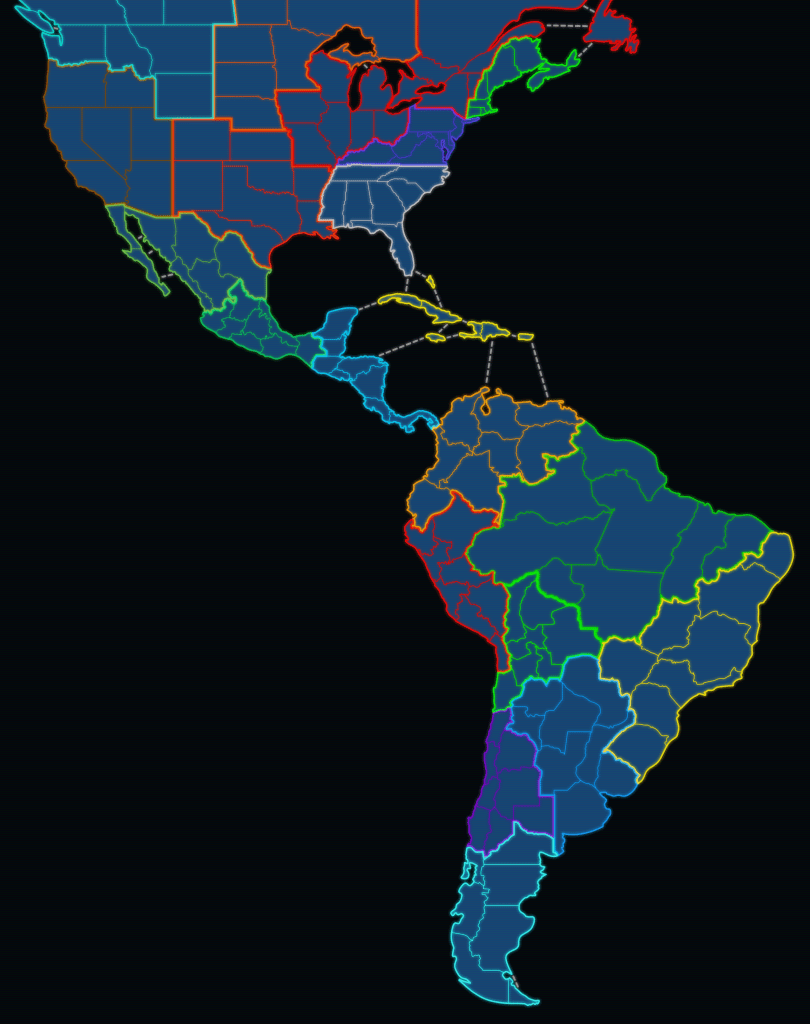
Welcome to the Continental States of America.
Thirty years after the last world war, the “Conqueror of the Americas” reigns from sea to shining sea and pole to frozen pole. The blood-and-soil banner waves proudly over citizens and non-citizens alike, taunting the rest of the world as a reminder of their most recent military failure.
But that ignores the reality of the Continental States. Even if you dismiss the poverty, disease, inequality, and rising cost of living, it seems every American has their own reason to want the American Caesar gone. In the South, rebels have taken up arms once more against the forced assimilation, ethnic cleansings, and the abuses by their thirty-year occupiers. While in the more-assimilated Central Regions, corruption has reopened the century-old scars of colonialism. Even in the Northern heartlands of this Greater America, the impoverished masses chafe against the American Caesar’s brutality and naked cronyism .
Not that their “betters” seem to care. Peaceful protests against the dictatorial “king without a crown” have been met with beatings, arrests, disappearances, and civilians gunned down in the street. Day by day, peaceful revolution seems less and less impossible, while more and more see violent revolution as an inevitability.
Timeline of Events
1770s
The American Revolution began in April of 1775 with the Battle of Lexington and Concord. Following the British failure to capture Boston, Ethan Allen and Colonel Benedict Arnold would begin the Northern Campaign, capturing Fort Ticonderoga. The two would be reinforced by General Richard Montgomery, and the trio would capture Quebec City on New Year’s Eve.
To the south, Washington was able to hold New York in the Miracle at Long Island, where they managed to hold off a British army twice their size. While the war continued in the Americans’ favor, it was the 1777 Battle of Trenton that convinced the Kingdom of France that the Americans were capable of defeating their hated rivals, while the American victory in the 1778 Battle of Monmouth silenced any remaining concerns in Versailles.
1780s
While the 1781 Battle of Cowpens was the beginning of the end of the war in America, the 1780 Gordon Riots were the beginning of the end in Britain. What had once been an orderly, if massive, protest against the Papists Act of 1778 and the continuation of the war in the Americas had become a bloody slaughter that many feared would tear London, or even the United Kingdom, apart. British Regulars would be called in to restore order in the capital.
The following years would see a string of British defeats, including Cornwallis’ surrender at Yorktown, the Royal Navy’s defeat at Ushant and Dominica, and the capture of the valuable colony of Jamaica. This, combined with the Fall of Halifax and further instability in Britain and Ireland, would lead to Lord Shelburne entering negotiations.
The Treaty of Paris saw the British cut their losses and cede all of North America to their former colonies. Though victorious, the Americans were tested with the First Shays’ Rebellion in 1786, which contributed to both the United States Constitution as well as the return of Washington and his subsequent landslide victory to become the first President.
When the French Revolution began across the Atlantic, the Shaysites were reinvigorated and radicalized. In what would become the Second Shays’ Rebellion, the Shaysites would fight a protracted war as vigilantes, mobs, and guerrillas throughout the United States.
1790s
While the Shaysites continue to harass tax collectors and the like across the nation, Washington is reelected to a second term in 1792. Citing the continued Shaysite insurrection, Washington reluctantly, yet successfully, wins reelection in 1796 after encouragement from Alexander Hamilton and John Adams. Across the ocean, Admiral Horatio Nelson died of his wounds at the Battle of Santa Cruz de Tenerife.
The continued Shaysite insurrection would lead the Federalist-led Congress to pass the Naturalization and Sedition Acts in 1797 despite protests from Thomas Jefferson and the Democratic-Republicans.
1800s
Under encouragement from the likes of Hamilton and Adams, Washington seeks a fourth term and is reelected in a landslide. Two years later, Washington concluded the Louisiana Purchase with Napoleon Bonaparte, doubling the country’s size. While American forces would not intervene in the Haitian Revolution, southern volunteers would fight alongside French forces during the latter’s reconquest of the island.
After over a decade of insurrection, Washington would finally finish off the Second Shays’ Rebellion in 1804. Rebel leader Daniel Shays is executed in the American capital of New York City (now known as Washington). With this success, Washington is sworn into his fifth term as President. It was around this time that Washington would be referred to as the “American Caesar,” an informal title he would carry for the rest of his life.
Three years later, George Washington passed away at age 76. Given his long reign, the humble gentleman farmer had inadvertently set a precedent for Presidents for Life. After a brief power struggle, he is succeeded by Alexander Hamilton as the second American Caesar. John Adams was kept on as his Vice President, and Thomas Jefferson left for Paris in exile.
Caesar Alexander I consolidated his position via what would later be known as the “Grand Compromise.” In exchange for the south’s support and compliance, Caesar Alexander I adopted a foreign policy of expansionism and cheap land in the territories.
1810s
In light of continued British impressment of sailors and Hamilton adopting a policy now known as “Political Realism,” the United States intervened in the Napoleonic Wars on Napoleon’s side, seizing the remaining British territories in the Caribbean along with Bermuda. By diverting British forces, the second American Caesar would inadvertently lay the groundwork for the 1818 Invasion of London.
After the installation of Napoleon’s new order, Caesar Alexander I and Emperor Napoleon I would formalize their alliance in 1820. The two monarchs would turn their focus to the Americas, where they supported revolutionaries under Simon Bolivar and Jose de San Martin against the Bourbon Royalists who had fled to South America.
1820s
As the Latin American rebels saw great successes against their former colonial overlords, the United States was able to conquer the Bourbon-aligned island of Cuba and the rest of the Spanish Caribbean in the ensuing chaos. For his part, Napoleon I would be able to rid himself of several claimants to his brother’s rule in Spain, forcing the remaining Bourbons to flee to the Philippines.
1830s
In 1835, Caesar Alexander I Washington-Hamilton passed away. He is succeeded by his son, Caesar Phillip I Washington-Hamilton. Like his father before him, the new Caesar is a military man, and he would personally lead the United States Army to victory against the Mexicans in the Texas Revolution. Texas would be annexed into the United States within a year’s time.
1840s
The United States would fight a revanchist Mexico in the Mexican-American War. Caesar Phillip I would lead the Americans to victory over the next two years. Terms were set, and the United States would annex all of Mexico. Which the nation would then spend the next three decades pacifying.
Across the ocean, the Bonaparte Dynasty was overthrown in 1848 and forced to flee to America. Over the next few years, nations throughout Western and Central Europe overthrow their Bonaparte leaders in favor of republics in what many call “The Springtime of Nations.” As for the Bonapartes themselves, Caesar Philip’s son Alexander George Washington was married to the daughter of the deposed Napoleon II, forever joining the two families.
Hispaniola, the last holdout of Bonaparte support, was annexed by the United States in 1849. Though Haiti and Dominica achieved statehood, the Bonaparte Dynasty would continue to dominate the states’ politics for over a century
1850s
With the Army largely busy in Mexico and increasing unrest over slavery, Caesar Phillip I sent General William Walker to Central America. Over the next ten years, Walker and his army of mercenaries would establish multiple pro-American regimes that would then be annexed into the United States. For his work, Walker was appointed Governor of Central America.
1860s
To prevent a Civil War and finally settle the slavery issue, Caesar Phillip I created a system of manumission in which each slave would be bought in exchange for land in Mexico. This, coupled with backroom politicking, would prevent a brewing secessionist movement in the Southern and Caribbean states. Though slavery was officially outlawed, the implementation of segregation would ensure that American freedmen were enjoyed few freedoms beyond that.
1870s
In the Second Springtime of Nations, the last monarchs of Europe are sent into exile. Republics are declared from Dublin to the Danube. Across the Atlantic, Caesar Phillip I Washington is succeeded by his son, Caesar Alexander II Washington. His first act is to seize the remaining European territories in the Caribbean.
On the centennial of the nation, Caesar Alexander II declares the Mexican occupation a success, and proclaims that America is entering a new era. To begin, he would rechristen the nation as the “Continental States of America” and wholeheartedly embraces the concept of Manifest Destiny with the claim that America would one day rule from “Sea to Shining Sea” and “Pole to Frozen Pole.”
1880s
In the London Conference, the European republics agree to partition Africa. By the turn of the century, all of Africa will be split amongst them, along with the Arabian Peninsula. America, for its part, was not invited by the liberal republics of Europe.
Undeterred by the diplomatic insult, the Americans turn to the East, where diplomats open relations with Korea, Japan, and China. While the three nations would resent the Americans’ appeal to force, the Continental States would serve as a counterbalance to further European influence.
1890s
After decades of insurrection, the states of Central America are formally integrated into the CSA. With American aid, the Empire of Japan was able to rapidly modernize past the Qing Empire, whose prestige waned with every concession granted.
Left with no other option, the Qing and Korea switch sides and ally themselves with the European powers
1900s
At the turn of the century, Caesar Alexander II died, and is succeeded by his son, Caesar George II. Across the ocean, the European Republics united into a new alliance, the United Nations of Europe and Africa.
In response, the Japanese and Americans formed an alliance to combat European influence in East Asia. To that end, both Tokyo and Washington would begin to back anti-colonial independence movements across the region.
In 1905, the East Asian war began, with the CSA-backed Japanese squaring off against the Qing in Korea, while CSA forces fought through colonial holdings in Indonesia and the Philippines. After five years of bloody warfare, the Japanese and Americans would emerge victorious. East Asia has fallen under the control of the Japanese, while the Americans would seize the British protectorate of Hawaii.
1910s
After the humiliation of the East Asian War, the Qing Empire was overthrown by Charlie Soong with the help of Japanese and American volunteers and arms. Despite his best efforts, Sun’s death in 1919 led to the fracturing of the nation for almost fifty years.
European efforts to expand their influence in South America ultimately led to the issuing of the Corollary to the Washington Doctrine, beginning the Interventionism Period of CSA foreign policy in South America.
1920s
While the CSA is effective in intervening in South American affairs to protect their interests, this has the unintended consequence of creating resentment among many South Americans. A similar phenomenon occurs in the Latin American states, where the continued monopolistic and often-exploitative tactics of large corporations in the regions had created an atmosphere of resentment among the locals. Later historians would argue that this was part of a growing culture of corruption across the nation.
Despite their governments’ more-conservative views, European agents began meeting with leftist leaders in South and Central America, with the promise of training, weapons, and funds to combat their American-friendly leaders, and by extension, the CSA as a whole.
1930s
After decades of prosperity that ultimately resulted in an economic collapse, Caesar George II was assassinated in 1935 in the Business Plot, possibly in retaliation for his reformist proposals. His young, more business-friendly son John, is quickly sworn in as Caesar John I Washington. A new age begins, with talk of American Freedom, Exceptionalism, Efficiency and Progress.
Sensing weakness, European forces attacked the Atlantic Fleet at Bermuda and the Pacific fleet at Sapporo in late 1936. For the first time in almost thirty years, America was at war, and with the youngest Caesar in its history. European forces flooded through Alaska and invaded the Caribbean. To the South, the anti-American “Southern Spring” swept through South America in 1939, with the entire continent falling to European-backed workers’ rebellions.
1940s
In the 1940 Battle of Alaska, American troops managed to push the European forces out of Alaska. Greenland falls by Christmas. The Caribbean is slowly being recaptured in an island-hopping campaign. By the spring of the next year, the last European holdouts were defeated in Bermuda. After over half a decade of war, America is whole once more.
With the Imperial Japanese Navy conquering Sakhalin and Indochina with ease and patrolling the seas in the Pacific, as well as the naval stalemate in the Atlantic, the CSA turned their sights southwards by 1941. The Rainforest Wars are the bloodiest in world history, with the United States and Asian Expeditionary Forces working to stamp out the last vestiges of Socialism in the Americas, and with it, the last vestiges of European interference. In eight years of bloody conflict, the Americans and their Asian allies conquered the continent.
Behind closed doors in Washington, a committee of businessmen, leaders, and the young Caesar himself discussed the next steps. Topics include economics, personnel requirements, economics, Americanization, and most importantly, propaganda, all of which set the groundwork for the Greater American Co-Prosperity Sphere. By the time the 1949 Treaty of Washington Harbor was signed to end hostilities, their plans were already in motion.
1950s
In the wake of the war, both the Americans and the Japanese had found themselves facing a war-weary populace on the homefront and mounting insurrections in their conquered territories. To solve this problem, as well as the mounting unemployment at home, several Zaibatsu decided to cooperate and form the Kirihara Group, a mercenary organization designed to protect and further their interests, as well as that of the Japanese, both at home and abroad.
Seeing the successes of the Kirihara Group, several prominent American businessmen and the American Caesar himself formed a similar organization, Continental Armed Security Services, to assist in their occupation and reconstruction of South America.
He would be much less successful on the domestic front. While the young Caesar had proposed an ambitious program of reforms and modernizations, interference from the Business Council would block it at every turn. One of the few developments that did make it through was the formation of the Office of Strategic Actions. This new intelligence agency would be founded and led by famed war hero William C. Lawrence, an ally and confidant of the American Caesar since the latter’s rise.
1960s
The African Independence Wars saw Continental Security troops contracted in Africa and Arabia to fight independence wars on nearly every front against the European colonial forces. When the dust settled, it was the freedom fighters and their mercenary allies claiming victory in the Heart of Darkness and Arabia. In victory, the darkness of colonialism was burned away, though many have grumbled that their liberators are little better than their former overlords.
With Continental Armed Security Service’s victories in Africa, as well as their continued work in South America, the American Caesar’s mercenary organization saw unprecedented growth and expansion to both North and Central America. Despite John I’s stake in the organization, a hostile takeover in 1965 would see control of Continental Security switch to the Business Council. For all intents and purposes, he had lost control of the world’s largest private army.
As icing on the cake, a subsidiary mercenary company, the United African Company, would be spun off. Ironically, many of the defeated colonial troopers would be hired to rule over the people that’d once rebelled against them.
Having never forgotten their Chinese comrades, the Americans and Japanese turned to the east to intervene in the still-divided nation. On January 1, 1968, Kirihara and Continental Security would launch a joint intervention in the region.
1970s
For the next three years, forces of the Mukden Clique, backed by Kirihara and Continental “advisors” and weapons, would overrun the divided warlords. Come October 1970, and the Second Republic of China had been declared in Beijing. Its leader, President Yuan Guowei, has sought to model himself after the American Caesar.
On New Year’s Day of 1971, the American Caesar died of a protracted illness. With his firstborn son dead, the title would go to his second son Justin. Having grown up in the shadow, Caesar Justin I Washington-Hamilton intends to emulate his father’s successes, though he seems to lack his father’s ability, charisma, or self-control. The young Caesar seems to prefer the blunt use of brute force to prove himself a worthy successor.
While Caesar Justin has spent the last five years speaking highly of his abilities and what he would call successes, the young Caesar has, in fact, done little more than become a puppet to his cronies and a tyrant to many of his subjects. Whether it be deploying Continental Security mercenaries against civil rights activists and union leaders or the declaration of Martial Law, the American Caesar seems to care little, so long as he and his backers stay in the black.
Nevertheless, the Continental States of America is still the strongest nation despite its overstretched mercenary forces, the richest nation despite its poverty and inequality, the largest nation despite the separatist movements born from mistreatment, and arguably the greatest nation despite the misery and suffering that seem to be ignored.
At the same time, the CSA is a powder keg; men and women across the nation have taken a stand against the American Caesar with the soapbox, the ballot box, and the cartridge box. Though some fight to restore democracy while others fight for their people’s independence, it seems that they all can agree that the American Caesar must fall.


